Carnegie International 2013 with kids
Ever since my earliest days of blogging (long before China was even a thing for us), I've blogged about taking kids to art museums and their reactions to what they see there. I'm still at it, though my kids are now 10 and 5, and not adorable, grabby one-year-olds.
We had a little time over our winter sojourn to visit the 2013 Carnegie International, the special every-few-years-or-so-ienniel exhibit of the contemporary art. We didn't get to see the whole show, even as small as this years' was, but we did have a few memorable moments over two visits, one of which was with my almost-five-year-old niece Evangeline in tow.
More after the jump
In front of the museum stood this massive sculpture, TIP, by Phyllida Barlow. It was giant, messy, and a bit frightening for Brigid. Myles was very interested in determining the materials used; for him the process of art is almost as cool as the product. I had to agree. I see something this big and ambitious, and I immediately start to break it apart and categorize it in my head.
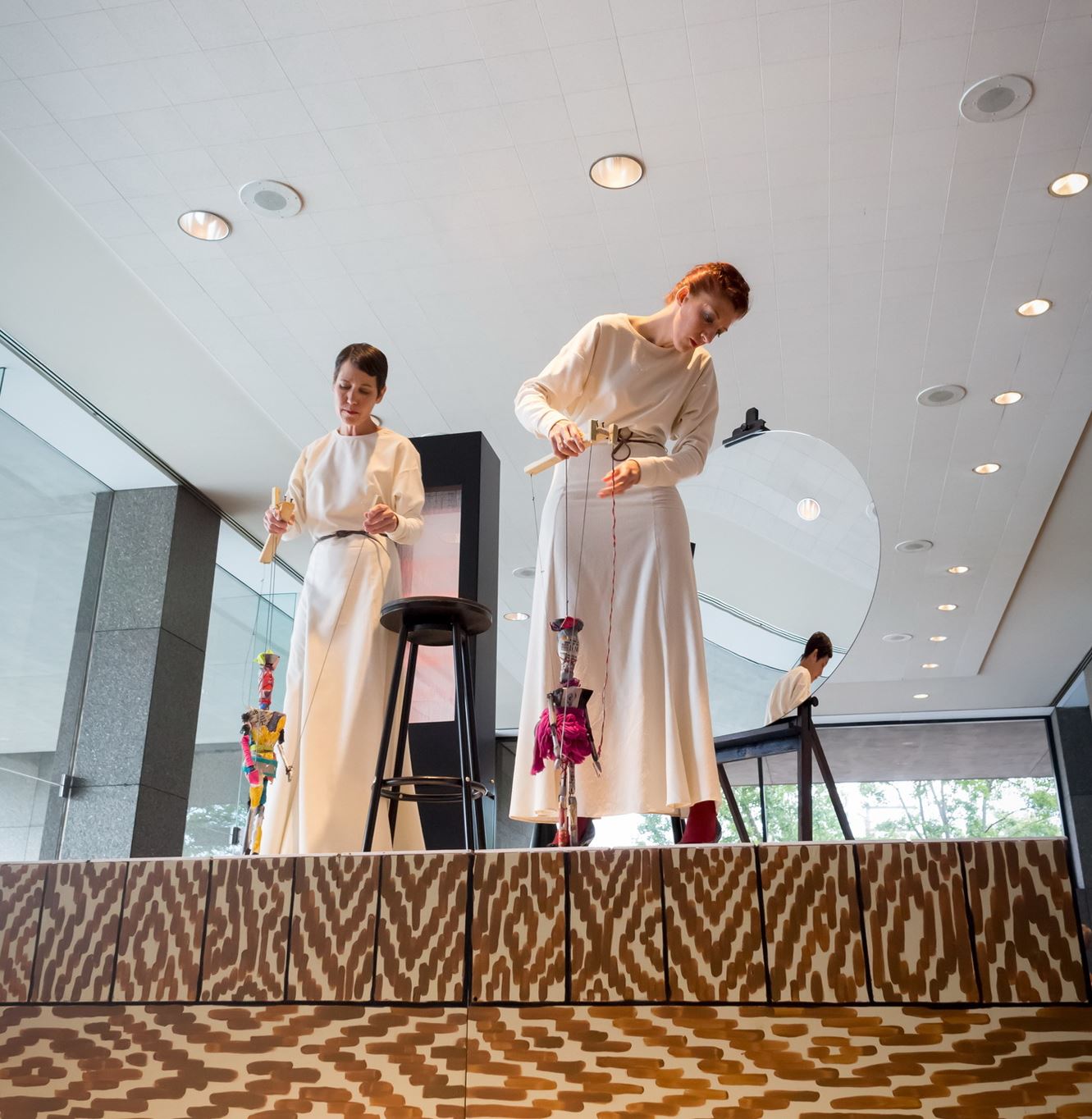
Just inside the front entrance, in the cafe area, were the puppets of Tom Sarver matched with Paulina Olowska's installation Puppetry in America is a Lonely Craft. We lunched in front of the puppet cabaret stage Olowska constructed, and watched the video loop of a marionette performance by Joann Kieler and Kristen Barca. Brigid saw this and kept singing, "High on the hill is the lonely Goatherd, Yodel lay hee hoo!" Is there ever a time or place when the soundtrack to The Sound of Music does not fit?
Brazilian artist Erika Verzutti had an entire room in which to install her sculptures, a mix of primitive- and natural-looking objects composed of concrete, bronze, stone, and other materials. These appeared a lot like the kinds of artifacts we might see in the Natural History Museum, but were instead more recently produced. Among these, Myles was really drawn to Mineral which were fashioned to look like geodes. He said they reminded him of one of our theories, that all the geodes for sale in decorating shops around the world are not really natural but actually manufactured. Too many of them look alike, he said.
"Hey Mom!" Brigid said coming out from Verzutti's room into the hallway. "There are giant Chinese words over there!"
There on the wall was the artwork of He An, a great idea of an installation, using scrapped light-up signs to spell out in Chinese his father's name and the name of an Japanese adult-film actress (though I only told the kids she was an actress, just a plain old actress). I'll have a separate post on He An and the other Chinese artist featured in the International.
Among all the artists Lara Favaretto was one of Brigid's and Evangeline's favorites. The bright red cube of her sculpture Jestem was impossible not to love.
Pedro Reyes' installation Disarm (Mechanized) I used as a reward for good behavior. "Do you want to see the really loud thing?" I dangled this question in front of my niece and Brigid like a carrot. It worked, by the way.
This installation was built from weapons that had been transformed into self-playing musical instruments. The kids waited for the loop to start, with one of the instruments striking alone, to another, to several playing together in a crescendo. The girls' faces say so much about their approach to this piece. Brigid was excited for the cacophony to build, and Evangeline was much more thoughtful and discerning.
There was one more part of the International that was a big hit with the kids, but we saw it in the summer. The Playground Project at the Heinz Architecture Center was a program on contemporary playspaces around the world that coincided with the International. For children, the best part was the Swiss Lozziwurm. We did not get to enjoy it this visit because it was cold and snowy.
However, this summer it was a highlight of a Carnegie visit, by consensus the best art installation of all.
We had a little time over our winter sojourn to visit the 2013 Carnegie International, the special every-few-years-or-so-ienniel exhibit of the contemporary art. We didn't get to see the whole show, even as small as this years' was, but we did have a few memorable moments over two visits, one of which was with my almost-five-year-old niece Evangeline in tow.
More after the jump
In front of the museum stood this massive sculpture, TIP, by Phyllida Barlow. It was giant, messy, and a bit frightening for Brigid. Myles was very interested in determining the materials used; for him the process of art is almost as cool as the product. I had to agree. I see something this big and ambitious, and I immediately start to break it apart and categorize it in my head.
Just inside the front entrance, in the cafe area, were the puppets of Tom Sarver matched with Paulina Olowska's installation Puppetry in America is a Lonely Craft. We lunched in front of the puppet cabaret stage Olowska constructed, and watched the video loop of a marionette performance by Joann Kieler and Kristen Barca. Brigid saw this and kept singing, "High on the hill is the lonely Goatherd, Yodel lay hee hoo!" Is there ever a time or place when the soundtrack to The Sound of Music does not fit?
Brazilian artist Erika Verzutti had an entire room in which to install her sculptures, a mix of primitive- and natural-looking objects composed of concrete, bronze, stone, and other materials. These appeared a lot like the kinds of artifacts we might see in the Natural History Museum, but were instead more recently produced. Among these, Myles was really drawn to Mineral which were fashioned to look like geodes. He said they reminded him of one of our theories, that all the geodes for sale in decorating shops around the world are not really natural but actually manufactured. Too many of them look alike, he said.
"Hey Mom!" Brigid said coming out from Verzutti's room into the hallway. "There are giant Chinese words over there!"
There on the wall was the artwork of He An, a great idea of an installation, using scrapped light-up signs to spell out in Chinese his father's name and the name of an Japanese adult-film actress (though I only told the kids she was an actress, just a plain old actress). I'll have a separate post on He An and the other Chinese artist featured in the International.
Among all the artists Lara Favaretto was one of Brigid's and Evangeline's favorites. The bright red cube of her sculpture Jestem was impossible not to love.
Pedro Reyes' installation Disarm (Mechanized) I used as a reward for good behavior. "Do you want to see the really loud thing?" I dangled this question in front of my niece and Brigid like a carrot. It worked, by the way.
This installation was built from weapons that had been transformed into self-playing musical instruments. The kids waited for the loop to start, with one of the instruments striking alone, to another, to several playing together in a crescendo. The girls' faces say so much about their approach to this piece. Brigid was excited for the cacophony to build, and Evangeline was much more thoughtful and discerning.
There was one more part of the International that was a big hit with the kids, but we saw it in the summer. The Playground Project at the Heinz Architecture Center was a program on contemporary playspaces around the world that coincided with the International. For children, the best part was the Swiss Lozziwurm. We did not get to enjoy it this visit because it was cold and snowy.
However, this summer it was a highlight of a Carnegie visit, by consensus the best art installation of all.
Comments